Consonants - Souhlásky
Basic information
Consonants are sounds articulated with a partial or complete closure of the vocal tract.
In other words, the airflow meets an obstacle—formed by the tongue, teeth, lips, or a combination of them—which creates the sound when released.
The only exception is the sound /h/, which is pronounced without any stricture in the vocal tract.
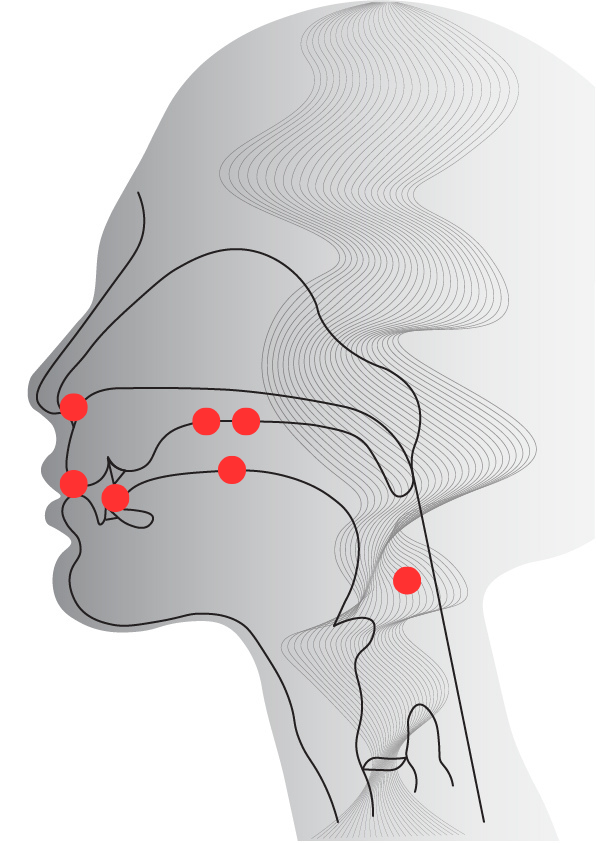
Czech has the following consonant phonemes:
/b/, /c/, /č/, /d/, /ď/, /f/, /g/, /h/, /ch/, /j/, /k/, /l/, /m/, /n/, /ň/, /p/
/r/, /ř/, /s/, /š/, /t/, /ť/, /v/, /z/, /ž/
The grapheme w appears only in loanwords and is pronounced the same as /v/.
The grapheme x, also used only in foreign words, is pronounced /ks/ (as in expert → /ekspert/) or /gz/ (as in existovat → /egzistovat/).
The digraph ch represents a sound similar to the Scottish /χ/ in loch /loχ/.
The digraph dž is sometimes used to represent the rare sound /ǯ/, as in džudo (also spelled judo).
Palatalization - Změkčování
Palatalization is a way of articulating a consonant with the tongue raised toward or touching the hard palate.
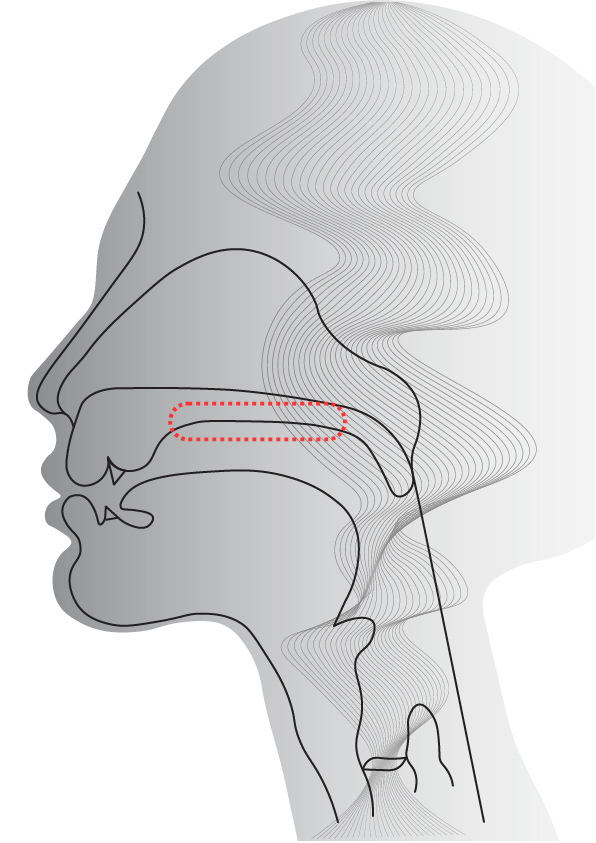
Palatalized consonants are also called soft (měkké souhlásky). The following pairs exist:
| Hard | Soft | Notes (for soft consonants) |
|---|---|---|
| /c/ citron (lemon) |
/č/ česnek (garlic) |
similar to the English ch in church [tʃɜːtʃ] |
| /d/ deset (ten) |
/ď/ ďábel (devil) |
similar the English d in duty [ˈdjuːtɪ] |
| /n/ nemoc (sickness) |
/ň/ kůň (horse) |
similar to the English n in new [njuː] |
| /r/ ruka (hand, arm) |
/ř/ řeka (river) |
no equivalent in English |
| /s/ syn (son) |
/š/ šíp (arrow) |
similar to the English s in sure [ʃʊə] |
| /t/ tanec (dance) |
/ť/ zeť (son-in-law) |
similar to the English t in Tuesday [ˈtjuːzdeɪ] |
| /z/ zelenina (vegetables) |
/ž/ žába (frog) |
similar to the English s in leisure [ˈleʒə] |
Palatalization is in spelling indicated:
-
With a háček (caron) that is placed above particular letter, for example:
c + ˇ → č
z + ˇ → ž ... and so on.
-
With a modified (apostrophe-like) caron on d and t:
d + ˇ → ď
t + ˇ → ťIn handwriting, the caron on d and t looks like: ď / ť.
-
With the following letter ě. This indicates:
-
Palatalized /ď/, /ť/, and /ň/:
dědeček - /ďedeček/ (grandfather)
těsto - /ťesto/ (dough)
něco - /ňeco/ (something) -
Additional /ň/ after m:
město - /mňesto/ (town, city)
směr - /smňer/ (direction) -
Additional /j/ after b, p, v, and f:
běžet - /bježet/ (to run)
pět - /pjet/ (five)
věřit - /vjeřit/ (to trust, to believe)
o žirafě - /o žirafje/ (about a giraffe)
-
-
With the following letters i or í. These indicate the palatalized pronunciation of
/ď/, /ť/, and /ň/:hodina - /hoďina/ (hour)
tisíc - /ťisíc/ (thousand)
nic - /ňic/ (nothing)
dílna - /ďílna/ (workshop)
stížnost - /sťížnost/ (complaint)
koníček - /koňíček/ (hobby)Foreign words do not follow this rule:
-
word modifikace is pronounced with non-palatalized d → /modifikace/
-
word titan is pronounced with non-palatalized t → /titan/
-
word nikl is pronounced with non-palatalized n → /nikl/
Note
An interesting case is the adjective panický, spelled identically but pronounced differently depending on meaning:
-
palatalized pronunciation /paňický/
-
non-palatalized pronunciation /panický/
-
Voicing - Opozice znělosti
Voiced consonants (znělé souhlásky) use vibrating vocal cords (e.g., /d/ or /z/).
The activity of vocal cords is diminished when sounds like /t/ or /s/ are produced. These consonants are called voiceless (neznělé souhlásky).
The following voiced (+) – voiceless (-) pairs exist:
| Voiced + |
Voiceless - |
|---|---|
| /b/ | /p/ |
| /d/ | /t/ |
| /ď/ | /ť/ |
| /g/ | /k/ |
| /h/ | /ch/ |
| /v/ | /f/ |
| /z/ | /s/ |
| /ž/ | /š/ |
The sounds /č/, /j/, /l/, /m/, /n/, /ň/, and /r/ have no pairs and both voiced and voiceless consonants can be pronounced before them.
The sound /c/ is always voiceless.
If a consonant has a voiced-voiceless opposition, only its voiceless variant can be used before another voiceless consonant. Assimilation also occurs at the end of a word.
To demonstrate the principle, let's break down the word lebka (skull):
    graph LR
    A["+<br /><b>l</b>"] --- B["+<br /><b>e</b>"]
     --- C["+<br /><b>b</b>"] --- D["-<br /><b>k</b>"] --- E["+<br /><b>a</b>"]
The sound /l/ does not have a voiced–voiceless pair. Vowels are only voiced, so /e/ and final /a/ are also marked with a plus.
The sound /b/ is voiced (+) and the following /k/ is voiceless (–). Here arises the need for a change, because two sounds with different voicing cannot be pronounced together smoothly. We can pronounce them separately while keeping their original voicing, but that is not what happens when we maintain the natural flow of sounds.
To resolve this, the /b/ sound goes to /p/
    graph LR
    A["+<br /><b>/l/</b>"] --- B["+<br /><b>/e/</b>"]
     --- C["-<br /><b>/p/</b>"] --- D["-<br /><b>/k/</b>"] --- E["+<br /><b>/a/</b>"]
Further examples:
| Spelling | Pronunciation | Meaning |
|---|---|---|
| obsahovat hrob |
/opsahovat/ /hrop/ |
to contain grave |
| Radka hned |
/ratka/ /hnet/ |
Radka (female name) at once, immediately |
| loďka pojď |
/loťka/ /pojť/ |
boat let's go |
| grog | /grok/ | grog |
| lehce svah |
/lechce/ /svach/ |
easily slope |
| ovce lev |
/ofce/ /lef/ |
sheep lion |
| otázka vůz |
/otáska/ /vús/ |
question vehicle |
| těžký věž |
/ťešký/ /vješ/ |
hard, difficult tower |
Sometimes, we can observe chain of changes.
Example: vztek (anger, fury)
    graph LR
    A["+<br /><b>v</b>"] --- B["+<br /><b>z</b>"]
     --- C["-<br /><b>t</b>"] --- D["+<br /><b>e</b>"] --- E["-<br /><b>k</b>"]
The /k/ sound changes the preceding z to /s/, and this /s/ then causes the preceding v to change to /f/. As a result, the word is pronounced /fstek/
    graph LR
    A["-<br /><b>/f/</b>"] --- B["-<br /><b>/s/</b>"]
     --- C["-<br /><b>/t/</b>"] --- D["+<br /><b>/e/</b>"] --- E["-<br /><b>/k/</b>"]
The devoicing can occur in various parts of a word:
-
odpověď (answer) → /otpověť/
-
vztah (relationship) → /fstach/
Rarely, both consonants become voiced:
kdo (who)
    graph LR
    A["-<br /><b>k</b>"] --- B["+<br /><b>d</b>"]
--- C["+<br /><b>o</b>"] graph LR
A["+<br /><b>/g/</b>"] --- B["+<br /><b>/d/</b>"]
--- C["+<br /><b>/o/</b>"]Further examples: kdy - /gdy/ (when) or kde /gde/ (where).
Note
There are some interesting points related to the above. For example, in pronunciation there is no difference between the words:
- led → /let/ (ice)
- let → /let/ (flight)
Their meanings must therefore be understood from the context.
Devoicing of prepositions
Prepositions form a single phonetic unit with the following word, so assimilation applies.
Examples with v (in):
- v práci (at work) → /fpráci/
Because /v/ is voiced and /p/ is voiceless, the v changes to its voiceless counterpart. - v batohu (in the bag) → /vbatohu/
Both /v/ and /b/ are voiced, so no change is necessary. - v Americe (in America) → /f'Americe/
Before an initial vowel there is a slight, almost inaudible voiceless sound called ráz (a glottal stop). Therefore, the /v/ sound changes to /f/.
This applies to prepositions ending in a consonant:
- z, od, nad, pod, před, uprostřed, skrz
The devoicing of z (from) makes it sound identical to s (with), but meaning remains clear from context:
Petr přišel z práce. → /Petr přišel s práce./ (from work.)
Petr přišel s dcerou. → /Petr přišel s dcerou./ (with his daughter.)