Declension - Skloňování
Introduction
There are several approaches to presenting the reality of Czech declension, categorising words, and visualising them for learning purposes.
Various sources, both originally Czech and foreign, use different model words to represent groups that other words belong to. By doing so, they demonstrate that learning one group's declension enables a student to correctly use other words in the same group.
However, there are some challenges, such as irregular declension, consonant alternation, vowel shortening, mixed declension, and differences between formal and spoken language, which make visualising the declension system difficult to present.
Declension, generally speaking, is a system of morphemes (endings) that express internal relationships between words when we combine them to refer to the reality around us. Czech, as an inflected 1 language, uses endings to denote grammatical, syntactic, and semantic features. Simply put, a word exists in several forms, and each form has its own specific meaning and usage. This is mainly, though not exclusively, because inflected languages do not have a strict word order. 2
Words that undergo changes in their endings are called inflectional (ohebná slova). The parts of speech that undergo declension are:
Cases - Pády
To express relationships between words, the Czech language uses a system of seven cases. These cases are named using Latin terms (a principle used in linguistics worldwide) or numbered (a system used in Czech schools).
For the purposes of this guide, we use Latin terms (the following table is sortable):
| Scientific term | Czech scientific term | Abbreviation used in this guide 4 | Traditional Czech numbering | Question word |
|---|---|---|---|---|
| nominative | nominativ | NOM | 1. pád 3 | kdo, co |
| genitive | genitiv | GEN | 2. pád | koho, čeho |
| dative | dativ | DAT | 3. pád | komu, čemu |
| accusative | akuzativ | ACC | 4. pád | koho, co |
| vocative | vokativ | VOC | 5. pád | - |
| locative | lokál | LOC | 6. pád | kom, čem |
| instrumental | instrumentál | INS | 7. pád | kým, čím |
Question words are traditionally used in the Czech school system. In fact, they are the declensions of the interrogative pronouns kdo and co.
Seven Peters Example
The following example shows how one word (Petr) is changed in different cases.
Petře, věděl jsi, že Petr šel k Petrovi a viděl Petra, který byl u Petra s Petrem a mluvili o Petrovi?
Peter, did you know that Peter went to Peter's place and saw Peter, who was at Peter's with Peter, and they talked about Peter?
Case analysis:
(VOC)Petře , věděl jsi, že (NOM)Petr šel k (DAT)Petrovi a viděl (ACC)Petra, který byl u (GEN)Petra
s (INS)Petrem a mluvili o (LOC)Petrovi?
Syntactic analysis:
(ADRESSEE)Petře, věděl jsi, že (SUBJECT)Petr šel k (PLACE-DIRECTION)Petrovi a viděl (DIRECT-OBJECT)Petra, který byl u (PLACE-LOCATION)Petra s (OBJECT)Petrem a mluvili o (OBJECT)Petrovi.
Agreement
Words that create a logical cluster (such as attributes and modifiers) have to agree in the case.
-
(NOM)[Ten náš nový dům] je krásný.
[Our new house] is beautiful. (lit. [That our new house] is beautiful.) -
Do (GEN)[toho našeho nového domu] jsem se přestěhoval před dvěma roky.
I moved into [(that) our new house] two years ago. -
V (LOC)[tom našem novém domě] bydlím už dva roky.
I have been living in [(that) our new house] for two years.
Cases and their typical usage
Nominative
The nominative case (from Latin nomen - name) denotes the subject of a sentence. It is the lemma (dictionary form), so when working with a dictionary, this form always appears first.
(NOM)Petr studoval.
Petr studied.
The nominative is also used for:
-
the noun (nominal) phrase after být (to be):
(NOM)Petr je (NOM)[můj kamarád].
Petr is my friend. -
the adjective phrase after být (to be):
Petr je (NOM)starý.
Petr is old.
Genitive
The genitive case (from Latin genus - race, kind, birth) is used:
-
after various prepositions (see Genitive prepositions for a detailed overview):
Včera jsem šel do (GEN)školy.
I went to school yesterday. -
after certain verbs:
Bojím se (GEN)bratra.
I am afraid of my brother.
Ptám se (GEN)učitele.
I am asking the teacher.
See more genitive case verbs
| Infinitive | Example |
|---|---|
| bát se | Bojím se bratra. (I am afraid of my brother.) |
| obávat se | Obávám se války. (I am afraid of war.) |
| leknout se | Leknul jsem se hluku. (I was startled by the noise.) |
| ptát se / zeptat se | Zeptal jsem se učitele. (I asked the teacher.) |
| všimnout si | Nevšiml jsem si toho. (I didn't notice that.) |
| vážit si | Vážím si tvé pomoci. (I value your help.) |
| dosáhnout | Dosáhl jsem svého cíle. (I reached my goal.) |
| dotknout se | On se dotknul toho tlačítka. (He touched that button.) |
| zbavit se | Zbavil jsem se starého auta. (I got rid of my old car.) |
| vzdát se | Vzdal jsem se naděje. (I gave up hope.) |
| zúčastnit se | Zúčastnil jsem se schůzky. (I attended the meeting.) |
| týkat se | To se mě netýká. (It doesn't concern me.) |
| využít | Využil jsem té příležitosti. (I took advantage of the opportunity.) |
-
to express the entity-of-entity principle:
-
possessive meaning:
To je dům (GEN)[mého kamaráda].
That's my friend's house. / That's a house of my friend. -
partition meaning:
Vypil jsem láhev (GEN)vína.
I drank a bottle of wine.
-
-
after certain numerical expressions:
-
numbers from five and higher:
pět (GEN PL)kamarádů (five friends)
dvacet devět (GEN PL)korun (twenty-nine crowns)
sto (GEN PL)lidí (one hundred people) -
indefinite quantifiers:
několik (GEN PL)studentů (several students)
hodně (GEN SG)sněhu (a lot of snow)
-
Dative
The dative case (from Latin casus dativus - case of giving) is used:
-
after various prepositions (see Dative prepositions for a detailed overview):
Včera jsem šel k (DAT)lékaři.
I went to the doctor yesterday. -
to express the indirect object:
Řekl jsem (dOB ACC)to (iOB DAT)Petrovi.
I told it to Petr.
Accusative
The accusative case (from Latin casus accusativus - relating to an accusation or (legal) case) is used:
-
after various prepositions (see Accusative prepositions for a detailed overview):
To je dárek pro (ACC)Petra.
It's a gift for Petr. -
to express the direct object:
Viděl jsem (dOB ACC)Petra.
I saw Petr. -
in time expressions:
Přijedu (ACC)[tuto sobotu].
I will arrive this Saturday. -
in elliptical expressions:
(ACC)[Dobrou noc]!
(Wishing you a) Good night!
Vocative
The vocative case (from Latin vocare - to call) is used solely for addressing someone:
- (VOC)Petře, pojď sem!
Petr, come here!
Locative
The locative case (from Latin locus - a place, spot, position) is used only with certain prepositions (see Locative prepositions):
Petr byl v (LOC)práci.
Petr was at work.
Instrumental
The instrumental case (from Latin instrumentum - a tool, apparatus) is used:
-
after various prepositions (see Instrumental prepositions for a detailed overview):
Byl jsem tam s (INS)Petrem.
I was there with Petr. -
to indicate that a noun is the instrument or means by or with which the subject achieves or accomplishes an action:
Pojedu tam (INS)autobusem.
I will go there by bus. -
in passive constructions:
Smlouva byla podepsána (INS)právníkem.
The contract was signed by an attorney. -
after certain verbs:
Chci se stát (INS)pilotem.
I want to become a pilot. -
as a stylistic variant replacing the nominative in some expressions:
Petr je (INS)[mým nejlepším kamarádem].
Petr is my best friend.
Cases and parts of sentence
With some level of simplification, we can say that
-
The subject is in the nominative case.
-
The direct object is in the accusative case
-
The indirect object is in the dative case.
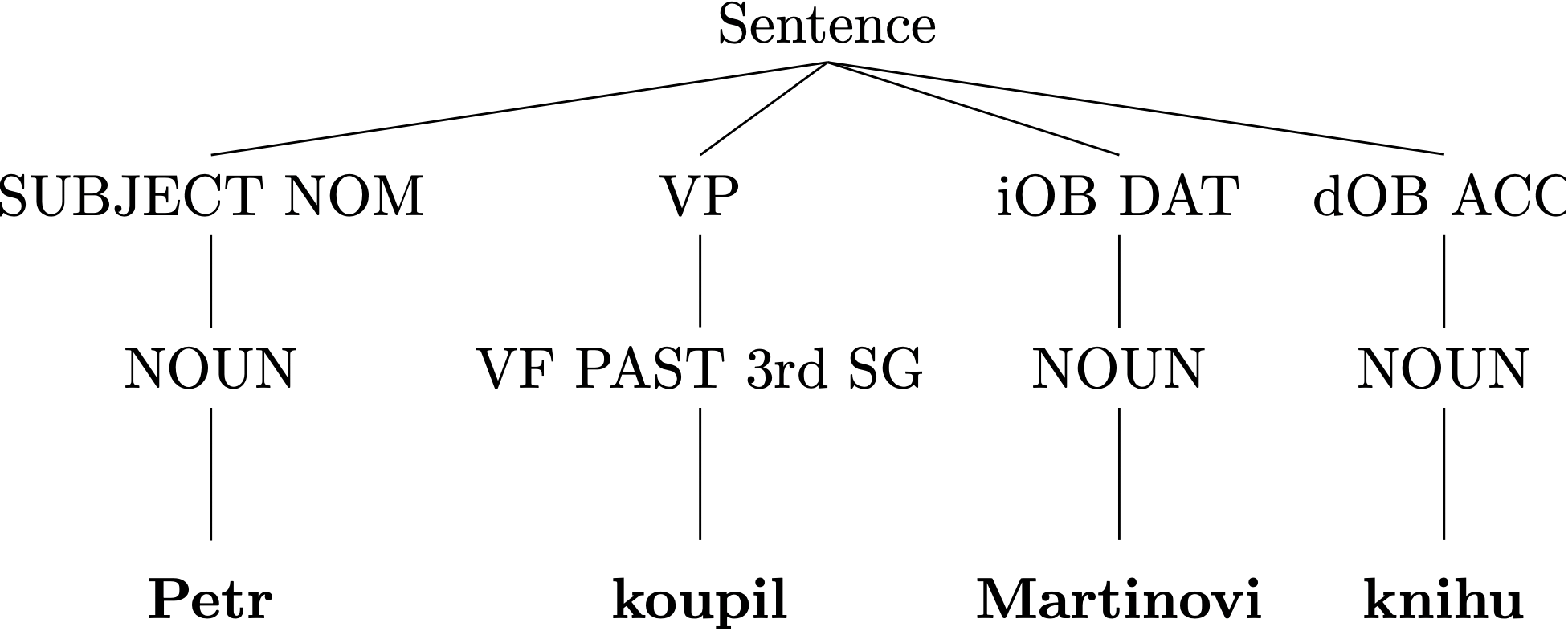
(SUB NOM)Petr koupil (iOB DAT)Martinovi (dOB ACC)knihu.
(SUB)Peter bought a (dOB)book for (iOB)Martin.
See the syntax tree:
Cases and prepositions
Grammatically, prepositions are very strong elements as they determine the case of the following word(s). From this perspective, Czech cases can be prepositional, non-prepositional, or both.0
| Case | Prepositional | Non-prepositional |
|---|---|---|
| NOM | ||
| GEN | ||
| DAT | ||
| ACC | ||
| VOC | ||
| LOC | ||
| INS |
More details
We can postulate the following:
-
NOM and VOC are non-prepositional cases only.
-
LOC is a prepositional case only.
-
GEN, DAT, ACC, and INS can be both prepositional and non-prepositional, with the use of a preposition historically determined by the verb.
-
The term fusional is also sometimes used. ↩
-
However, word order is not completely chaotic—the S-V-O (subject-verb-object) structure is commonly used. Visit the Word order page to learn more about the second-position rule and emphasised-position rule. ↩
-
An ordinal number is used, therefore 1. pád is pronounced as první pád, 2. pád as druhý pád etc. Check out page about ordinal numerals. ↩
-
See the overview of other abbreviations used. ↩